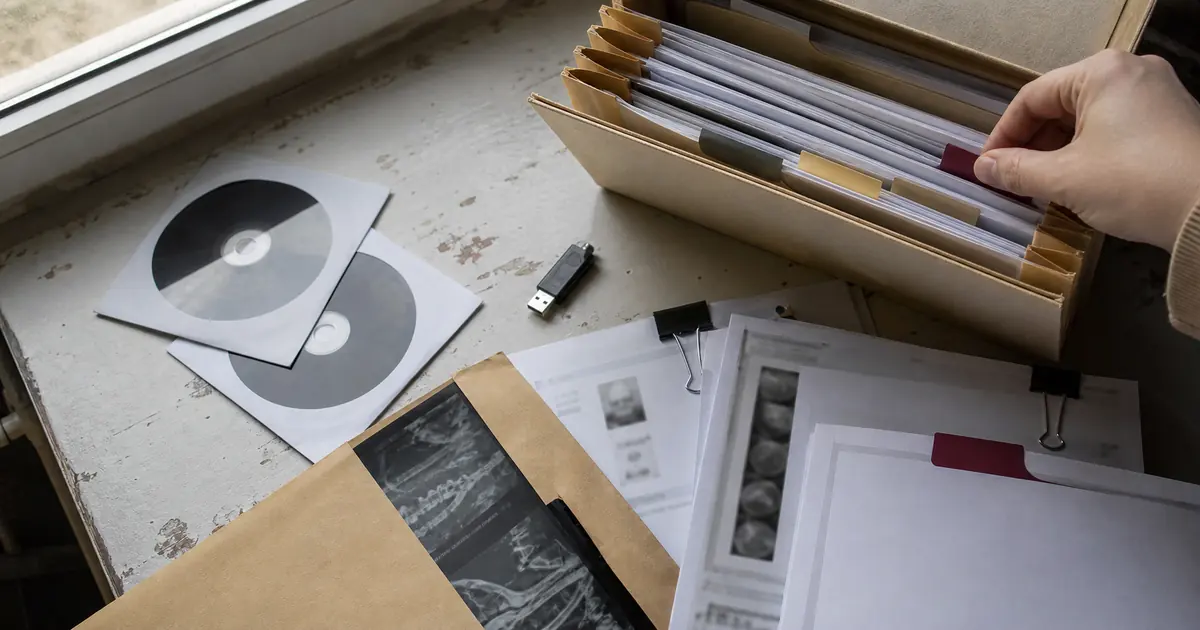
For planning only. A licensed clinician decides diagnosis and treatment. If symptoms may be urgent, use emergency services. Hospital access, fees, and insurance decisions come from the relevant organizations.
Start with an index, not a pile of files
Create a one-page cover sheet that identifies the patient, the current diagnosis or symptoms, the purpose of the review, and the records included. If the diagnosis is uncertain, say so. Put key dates in chronological order and state the one to three questions for the receiving team. This gives the reviewer a map without replacing the source documents.
Then build a manifest: one row per file, with document date, document type, institution, language, translation status, and a short note on relevance. A manifest exposes gaps early. It also prevents two versions of the same report from being mistaken for separate events.
Sources[1]DICOM Standards Committee / NEMA: DICOM current edition
What belongs in the clinical packet
The receiving department sets the final list. A cardiology review, cancer second opinion, orthopedic surgery inquiry, and routine outpatient visit do not need identical material. Start with the categories below, remove what is irrelevant, and obtain any additional item requested during triage.
Swipe horizontally to see all columns.
| Record | What to include | Preparation note |
|---|---|---|
| Clinical summary | Reason for review, timeline, established diagnoses, current symptoms, prior treatment, current plan | Keep it concise and date it; distinguish patient-reported history from documented findings. |
| Medicine and allergy list | Generic and brand names, dose, route, frequency, start date, known reactions | Mark medicines that were stopped and why; do not overwrite the historical list. |
| Consultation and discharge notes | Assessment, treatment course, procedures, complications, follow-up | Include the most relevant earlier note and the latest note, not every repeated template page. |
| Laboratory and functional tests | Result, units, reference range, specimen or test date | Preserve the original table. A typed list that omits units or ranges is hard to interpret. |
| Imaging | Radiology report plus original image study | Send DICOM data when requested; screenshots and photographs of films are not equivalent to the source study. |
| Pathology | Final report, addenda, biomarker or molecular reports, slide or block inventory | Physical material transfer needs instructions from both institutions and a tracked handoff. |
| Procedure records | Operation note, anesthesia record, implant or device details, endoscopy or intervention report | Include device model and serial information when relevant and available. |
Sources[2]Beijing Municipal Government: Beijing Friendship Hospital international medical services[3]Hainan Provincial Government: International medical institutions in Hainan[4]Jiahui Health: Jiahui International Hospital location and contact
Imaging and pathology need more than a PDF
DICOM is the international standard used to store and exchange medical imaging and related information. A DICOM study contains image data and metadata that a specialist viewer can use; the radiology report is a separate interpretation. Ask the imaging facility for both. Before sending, test that the archive opens and that it contains the expected patient, date, modality, and body area. Do not alter the internal DICOM file structure simply to make the folder look tidy.
Depending on the case, pathology review uses digital images, glass slides, paraffin blocks, or unstained slides in addition to the written report. Obtain the receiving laboratory's material list, labeling instructions, and return policy before dispatch. Keep an inventory with slide or block identifiers, courier tracking, sender, recipient, and custody dates. A translation of the report does not replace the specimen requested for independent review.
Sources[1]DICOM Standards Committee / NEMA: DICOM current edition
Name files so a clinician can find them
Begin each file name with a sortable date, then add the document type, relevant body site or specialty, and language. Avoid names such as scan1, final-final, WhatsApp Image, or a string of upload numbers. Preserve the original file separately if renaming could affect a hospital portal or digital signature.
Organize folders by year or record type, with as few nested levels as possible. The manifest remains the master index. If a portal imposes file-size or naming limits, prepare a portal copy while keeping the archival set unchanged.
Translate for the decision the hospital must make
First learn which language the receiving team accepts and which documents it needs for triage. A targeted translation usually begins with the case summary, latest specialist note, decisive imaging and pathology reports, operation or discharge notes, and the current medicine list. Add older records only when they explain a diagnosis, procedure, allergy, or treatment response.
Keep the source and translation paired but visibly distinct. The translation should retain headings, dates, units, reference ranges, negation, uncertainty, and names of medicines or devices. Transliteration alone may be unsafe when a medicine has an established generic name. If a certified translation is required for insurance, consent, immigration, or another administrative purpose, obtain the exact certification rule before work begins.
Swipe horizontally to see all columns.
| Check | What to look for |
|---|---|
| Patient and encounter | Name or identifier, institution, document date, specimen or examination date, author where shown |
| Clinical meaning | Negatives, qualifiers such as possible or ruled out, laterality, body site, stage or grade, and chronology |
| Numbers | Values, decimal points, units, reference ranges, dates, and measurements |
| Medicines | Generic name, dose, route, frequency, duration, and allergy or adverse-reaction wording |
| Document integrity | No missing pages, tables, footnotes, stamps, handwritten additions, or report addenda |
| Version label | Translator or service, completion date, source language, target language, and revision number |
Control access and versions
Medical files often contain passport details, diagnoses, genetic information, photographs, and contact data. Share them only with people who need them, through a channel intended for sensitive information. Record who received the packet and for what purpose. A broad group chat is hard to audit and continues exposing files after a person's role has ended.
Never edit the clinical content of an original record. When a correction arrives from the issuing hospital, retain the earlier document, label it superseded, and add the replacement to the manifest. Apply the same rule to translations: v2 should state what changed and which source it follows. At the end of the episode, give the patient an archival copy and a list of organizations that still hold material for follow-up.