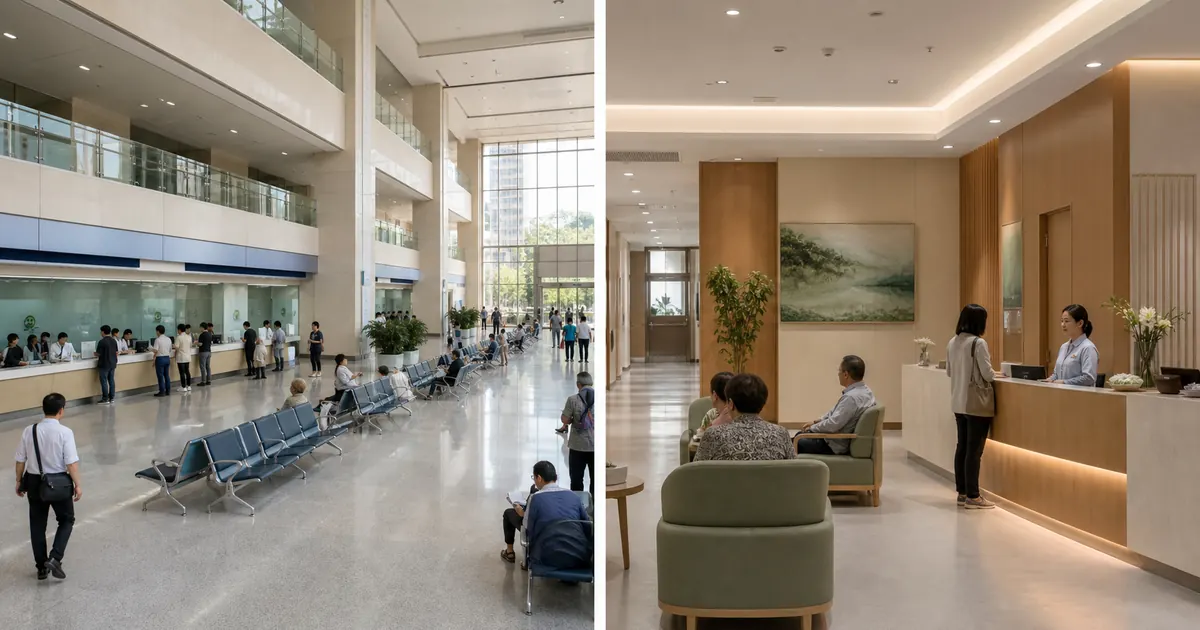
For planning only. A licensed clinician decides diagnosis and treatment. If symptoms may be urgent, use emergency services. Hospital access, fees, and insurance decisions come from the relevant organizations.
A side-by-side working comparison
The table describes common patterns, not rules. A public hospital's international department may operate very differently from its general outpatient clinics, and private hospitals vary widely in specialty depth and inpatient capability. Investigate the actual service unit.
Swipe horizontally to see all columns.
| Issue | Public hospital international department | Private international hospital |
|---|---|---|
| Specialty access | Often provides access to departments within a large tertiary or specialist hospital. | Often coordinates outpatient specialties and refers services outside its clinical scope. |
| Appointment | Department triage, a dedicated desk, app registration, or a limited clinic schedule are common. | Often uses centralized booking, though specialist and procedure availability still varies. |
| Language | International staff or interpreters often support parts of the visit; written documents frequently remain in Chinese. | Multilingual patient service is often integrated, but clinician and document language still needs to be established for the visit. |
| Inpatient care | Often connects to broad hospital resources; room type and international-service coverage still need review. | Offers a more consistent service environment when the necessary ward, intensive care, and supporting specialties exist. |
| Cost and payment | The international service often uses charges or deposits different from general outpatient care. | Service-level pricing is often easier to obtain, but the complete episode still depends on tests, medicines, devices, and length of stay. |
| Insurance | Direct billing is limited to specified insurers, plans, departments, or services where offered. | Insurance desks handle some international plans, subject to authorization and the exact provider arrangement. |
| Emergency care | The main hospital often has an emergency department, while the international unit's role and hours differ. | Emergency capability ranges from full emergency service to stabilization or referral; location and hours matter. |
Sources[2]Beijing Municipal Government: Medical Guide for Foreigners in Beijing[3]Jiahui Health: Jiahui International Hospital location and contact[4]Shanghai Municipal Government: Shanghai Parkway Hospital international services
Start with the clinical requirement
For a rare condition, major trauma follow-up, complex cancer, or care that crosses several specialties, access to the relevant clinical team and supporting departments may outweigh convenience. For primary care, pediatrics, routine follow-up, or a defined outpatient need, communication, scheduling, and continuity may dominate the decision.
If surgery or admission is possible, look beyond the consultation. Map anesthesia, intensive care, blood services, pathology, imaging, rehabilitation, and management of unrelated medical conditions. A polished outpatient pathway does not by itself establish that the full inpatient pathway fits the case.
Language is a chain, not a single checkbox
Break language support into the steps the patient will use: telephone or online booking, registration, clinical consultation, consent, testing, pharmacy, billing, discharge instructions, and later results. One English-speaking coordinator cannot replace interpretation during a complex clinical discussion, and an English consultation does not ensure that every report will be issued in English.
Decide which documents must be translated for the receiving clinician or insurer. Preserve the original text and identify who prepared the translation. When consent or a high-stakes decision is involved, the patient should be able to ask questions directly through a suitable interpreter.
Sources[2]Beijing Municipal Government: Medical Guide for Foreigners in Beijing[4]Shanghai Municipal Government: Shanghai Parkway Hospital international services
Compare the payment pathway before the headline price
A public international department may charge differently from the hospital's general service; a private hospital may bundle some services but not the entire episode. Request the consultation charge, likely tests, deposit policy, room assumption, and high-variation items in the same format. Then add travel and follow-up.
For insurance, give both the hospital and insurer the provider name, campus, department, service, and date. A broad statement that an insurer and hospital work together does not establish direct billing for that patient. Keep a self-pay and reimbursement plan available until the authorized route is documented.
Sources[1]Allianz Care: Pre-authorisation: what it is and when it may be required[2]Beijing Municipal Government: Medical Guide for Foreigners in Beijing
Choose according to the situation
Swipe horizontally to see all columns.
| Situation | Priority questions |
|---|---|
| Complex diagnosis or second opinion | Which department will review outside records? Are pathology, imaging, and multidisciplinary review available? Is travel required before an opinion? |
| Family outpatient visit | Can the appropriate clinician be booked at a workable time? What language and child-friendly support are available? How are prescriptions and follow-up handled? |
| Planned admission | Where will the patient stay? Which services are available overnight? What deposit, insurance authorization, companion, and discharge arrangements apply? |
| Possible urgent deterioration | Which facility provides the relevant emergency service now? Do not route an emergency according to a future elective-care preference. |