For planning only. A licensed clinician decides diagnosis and treatment. If symptoms may be urgent, use emergency services. Hospital access, fees, and insurance decisions come from the relevant organizations.
Give the consultation one job
“Please review my cancer case” leaves the receiving team to guess what the patient needs. State the decision in front of the patient: review of a diagnosis, comparison of a proposed plan, consideration of a procedure, transfer of ongoing care, management of a new finding, or an opinion after prior treatment. Add any genuine deadline created by an existing appointment or treatment plan.
Name the expected output as well. A hospital might offer preliminary record triage, a remote consultation, an in-person appointment, pathology review, imaging review, or a multidisciplinary discussion. These are different services. A request for an opinion is also separate from acceptance for treatment at that hospital.
Write the page that sits on top of the file
Start with a one-page summary. It lets the reviewer understand the chronology before opening individual reports and gives translators a stable reference for names, dates, and procedures. Use the terminology from the medical record; where the patient is unsure, label the point as a question rather than turning it into a fact.
End the page with no more than three questions. The questions belong to the current decision, not every issue encountered since diagnosis. If an answer depends on examination or missing evidence, the reviewer needs room to state that limitation.
Sources[1]National Cancer Institute: Pathology Reports[2]National Cancer Institute: Finding Cancer Care
Treat pathology as material with an identity
A pathology report identifies the specimen, the way it was obtained, the microscopic findings, and the pathologist's diagnosis. Additional molecular or biomarker results sometimes appear in separate reports. Send the complete signed report and any linked addenda rather than copying only the final line into the summary.
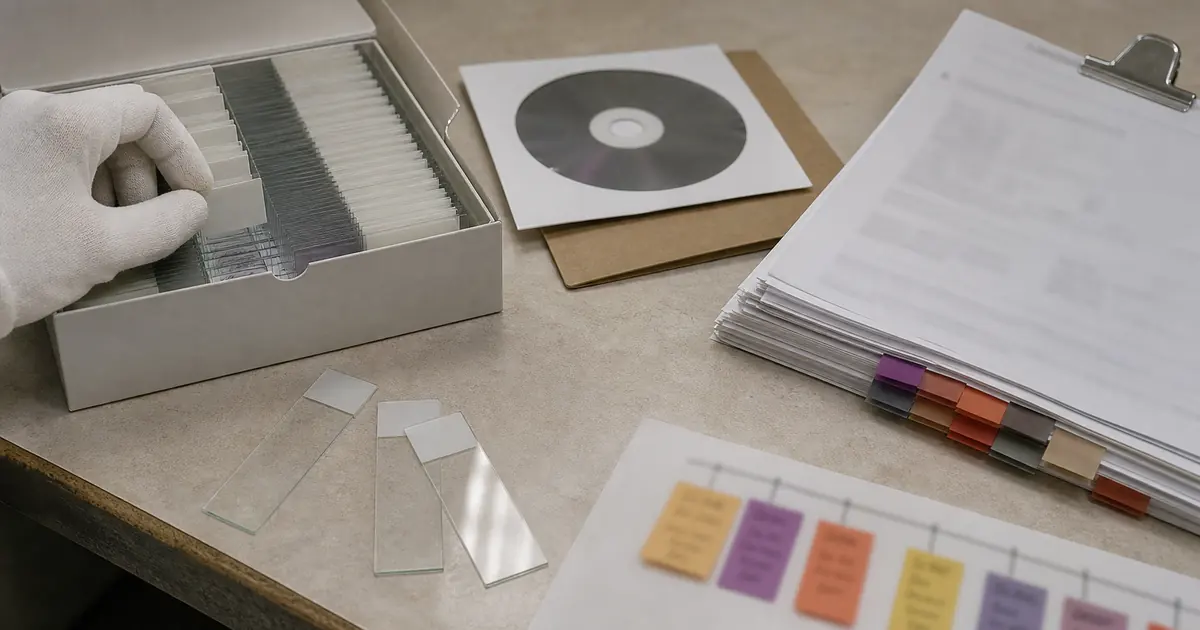
Slides and paraffin blocks are physical diagnostic material, not ordinary paperwork. Obtain the receiving institution's written requirements before requesting release or shipment. Record the pathology laboratory, accession number, specimen date, material type, number of items released, destination, and return instructions. The original hospital or laboratory remains responsible for its release process.
Translation does not replace the source report. Keep accession numbers, specimen labels, anatomic sites, dates, measurements, and test names aligned across the original and translated versions. Questions about the diagnosis belong to the reviewing pathologist or treating clinician.
Pair every imaging report with the study it describes
A PDF radiology report records one interpretation. The source study gives an authorized reviewer access to the images themselves. When the hospital accepts outside imaging, provide the DICOM export rather than screenshots, presentation slides, or photographs of a screen. Keep the viewer supplied by the imaging center only as a convenience; it is not the study.
Create an imaging manifest before upload or transfer. It exposes missing dates, duplicate series, and mismatched body regions while there is still time to correct the file.
Swipe horizontally to see all columns.
| Field | Entry to record | Reason |
|---|---|---|
| Study date | Date shown in the source system | Places the study correctly in the disease and treatment timeline |
| Modality | CT, MRI, PET/CT, ultrasound, X-ray, or other recorded modality | Helps the receiving team identify the study without opening every folder |
| Body region | Region and side exactly as recorded | Reduces confusion between similar examinations |
| Facility | Imaging center or hospital that performed the study | Provides provenance and a contact point for a corrected export |
| Files | DICOM study, report, and any comparison study requested | Separates source images from the written interpretation |
| Language | Original report language and translation status | Prevents a translation from being mistaken for the signed source report |
Sources[3]DICOM Standards Committee / NEMA: DICOM current edition
Build a treatment timeline from source documents
List treatment in date order and connect each entry to its source note. For surgery, include the operative and discharge records plus pathology generated by the procedure. For systemic treatment, record the medicine or regimen name exactly, dates or cycle numbers, dose changes documented by the treating team, and the stated reason for delay or discontinuation. For radiotherapy, include the treatment summary provided by the center.
Place the latest specialist note, laboratory results, and response assessment after the treatment entry they relate to. Mark pending tests as pending. Avoid describing a treatment as successful or unsuccessful unless that is the clinician's documented assessment; the consultation exists partly to interpret the evidence.
- Operative note and discharge summary
- Systemic treatment record with dates and documented changes
- Radiotherapy summary when applicable
- Pathology and molecular reports linked to the relevant specimen
- Imaging studies and reports in chronological order
- Latest laboratory results with units and reference ranges
- Current medicines, allergies, and recent clinical status
Sources[1]National Cancer Institute: Pathology Reports[2]National Cancer Institute: Finding Cancer Care
Wait for a review response before moving people or specimens
A published cancer center or international service establishes that a service exists; it does not establish fit for an individual case. Send the summary and the record manifest through the hospital's accepted channel, then obtain the offered service, department, format, required materials, and payment terms in writing. Keep preliminary triage separate from a medical opinion.
Do not book inflexible travel or dispatch pathology material on the strength of an unanswered inquiry. A receiving team might request another report, a pathology review, newer imaging, or an in-person examination before discussing care. If physical material is requested, use the releasing and receiving institutions' instructions for packaging, courier, customs documentation, tracking, and return. Generic shipping advice cannot substitute for those instructions.
Sources[2]National Cancer Institute: Finding Cancer Care[4]Shanghai Municipal Government: Shanghai Jiahui International Hospital